You have four functions to dress for, a wardrobe that mostly works, and a jewellery box that doesn't. This is the guest's problem at every Indian wedding — the outfits get sorted weeks ahead, and the earrings get decided in a panic on the morning.
The good news is that it's a much smaller problem than it looks. You don't need a different set for every event. You need to understand what each function is actually asking for, and then own three or four pairs that cover all of it.
Here's how to think about it.
The one rule that matters more than everything else
If the earrings are big, skip the necklace.
This is the single most common mistake at Indian weddings, and it's the reason a lot of expensive jewellery looks worse than a well-chosen single piece. A statement jhumka and a heavy necklace compete for the same attention, and neither wins. The look reads as cluttered rather than rich.
Wear one or the other. If you go with a large jhumka or chandbali, leave the neckline bare or wear a single thin chain at most. If you want a full necklace, keep the earrings small.
The practical benefit is that a single statement pair is far cheaper than a set, and looks more deliberate.
Mehendi and haldi — daytime, light, and something you can move in
These are the daytime functions, usually outdoors or in a bright hall, usually with dancing, and usually the longest. Whatever you wear will be on for six hours.
What works: mid-sized jhumkas in a bright colour. Daylight flattens everything, so a colour that reads well outside — yellow, peach, orange — does more than gold does at noon. Keep the size moderate; you're going to be sitting on the floor, hugging people, and possibly getting turmeric on yourself.
What to avoid: anything past about 80mm, and anything with a long fringe that catches in dupattas.
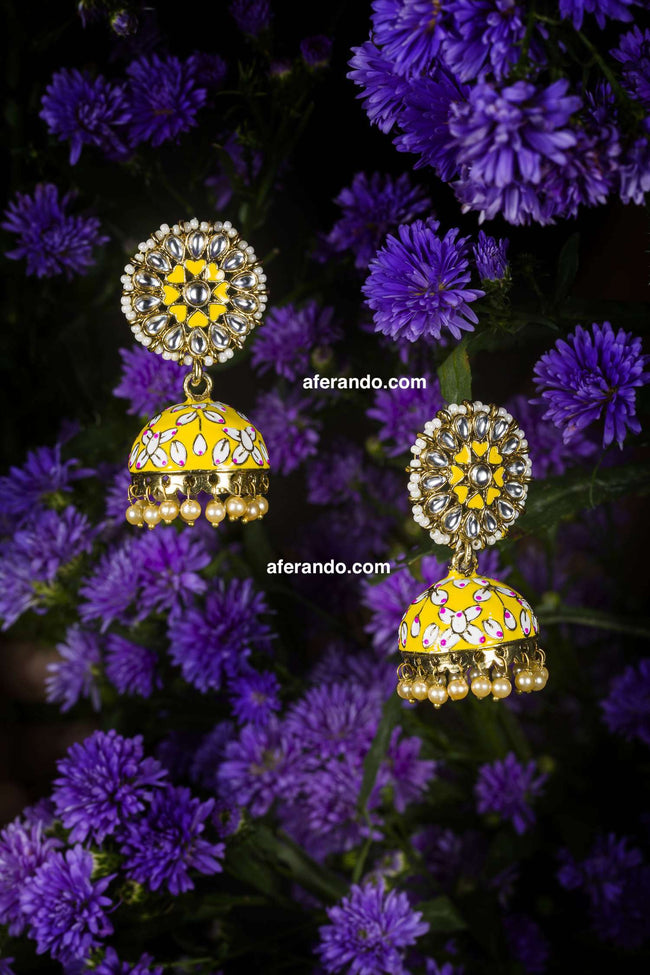
Good for mehendi
Yellow Meenakari Kundan Jhumka Earrings
Hand-painted yellow enamel that holds up in daylight, at a size you can dance in. Reads warm against both cotton and silk.
Shop now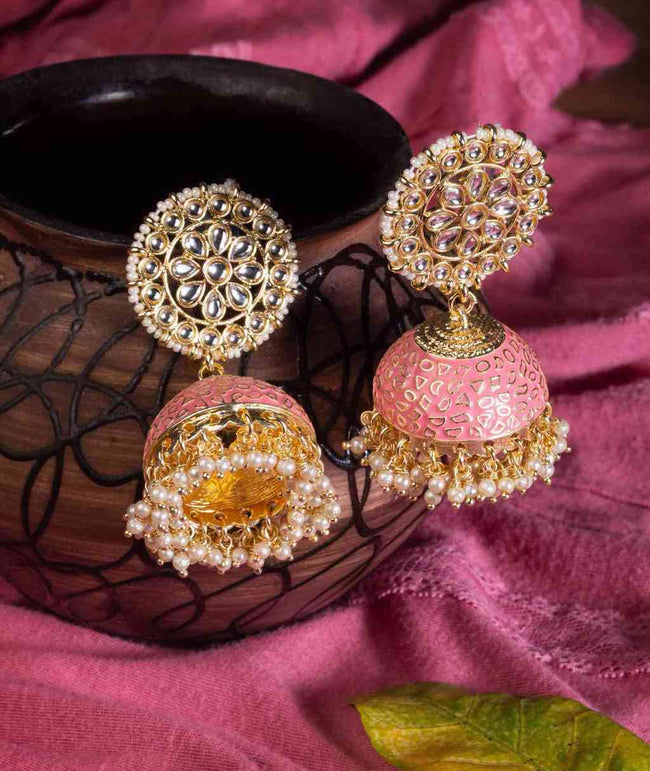
Good for haldi
Peach Meenakari Pearl Kundan Jhumka
Peach is the safest daytime colour there is — soft enough for morning light, warm enough not to wash out against yellow.
Shop nowSangeet — the one where you can actually have fun
Sangeet is the least rule-bound function of the lot. It's in the evening, there's dancing, and nobody expects traditional. This is where colour earns its place.
What works: a strong colour that isn't in your outfit. Rani pink against cream. Blue against mustard or beige. Orange against navy. Contrast is what makes both the earring and the outfit look deliberate — matching pink to pink almost always reads as accidental.
Size: go bigger here than anywhere else. Evening light and photography both flatter scale.
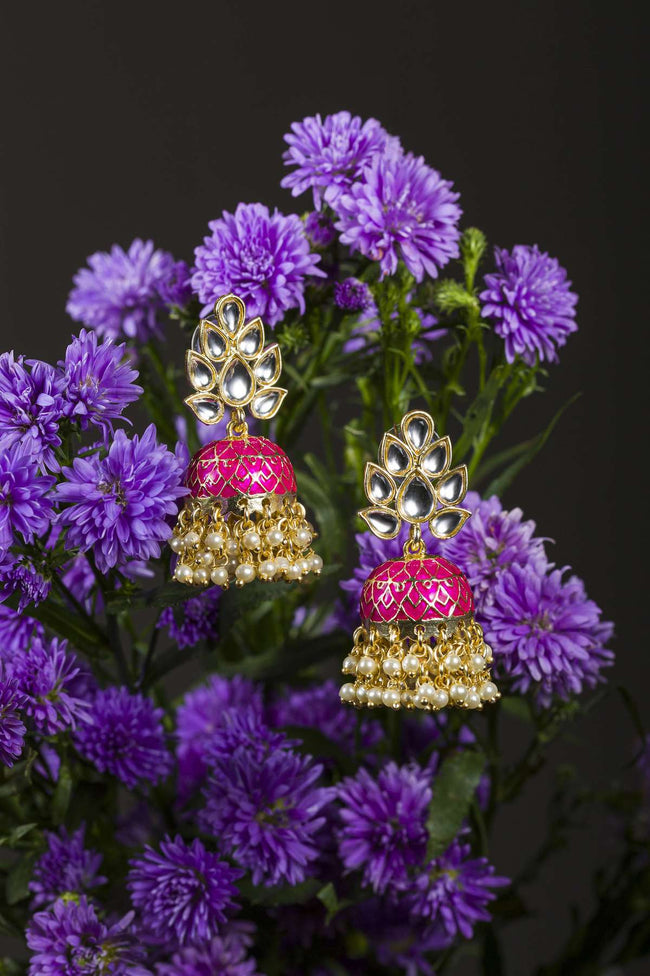
The safest colour bet
Rani Pink Meenakari Kundan Jhumka Earrings
Rani pink against cream, ivory or white is the strongest contrast in Indian jewellery. Wear it with a neutral and it becomes the only colour in the look.
Shop now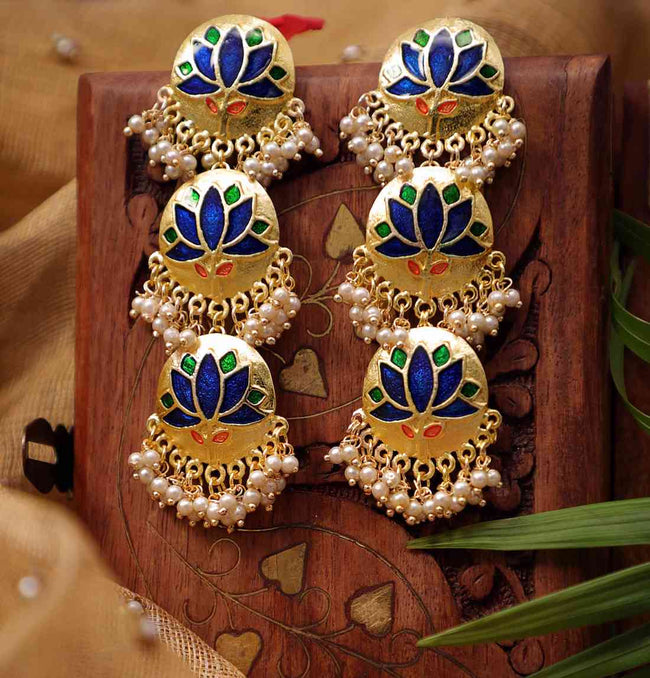
For maximum length
Blue Meenakari Triple Chandbali Earrings
Three tiers of hand-painted blue enamel. Long enough to move when you do, which is the whole point at a sangeet.
Shop nowThe wedding itself — this is where gold does the work
The ceremony is the most traditional function, and it's the one where you least want to be experimenting. It's also, usually, in daylight or in a mandap with mixed lighting, photographed constantly, and long.
What works: gold, antique gold, or temple styles. Gold is the only tone in ethnic jewellery that doesn't need to coordinate with anything — it sits with every saree colour, silk or cotton, and looks right in both daylight and artificial light. If you own one pair of statement earrings for weddings, make them gold.
Temple jewellery deserves a mention of its own. The motifs — deities, elephants, coins, lotus forms — come from South Indian temple traditions, and they read as more serious and more considered than plain gold. They're particularly good with silk.

If you buy one pair, buy this one
Golden Colour Kundan Statement Jhumka Earrings
Handcrafted kundan with a pearl fringe, at full statement scale. Gold goes with every saree you own, which makes this the most useful pair in the collection.
Shop now
Best with silk
Royal Temple-Style Gold Jhumka Earrings
Temple filigree with emerald and ruby-toned stones and a pearl fringe, in a warm gold finish. Made for Kanjeevaram and heavy silks, where a bright polish would look flat.
Shop now
Temple motif
Antique Gold Elephant-Motif Jhumka Earrings
Elephant motifs in a vintage gold finish — a traditional symbol of prosperity, and a design that reads as heirloom rather than fashion.
Shop nowReception — the one function where you can go modern
Receptions are the least traditional event of the wedding, often in a hotel, often with a mixed dress code, and frequently the one where guests wear gowns or Indo-western rather than a saree.
What works: oxidised and silver-look finishes, architectural shapes, and anything that doesn't read as obviously bridal. A dramatic chandbali in a cool tone works with a black saree or a dark gown in a way that gold simply doesn't.

For a black saree or a gown
Oxidised Silver-Look Rectangular Jhumka Earrings
Architectural rather than floral, in a cool oxidised finish. These are the pair for the outfit that isn't a saree.
Shop now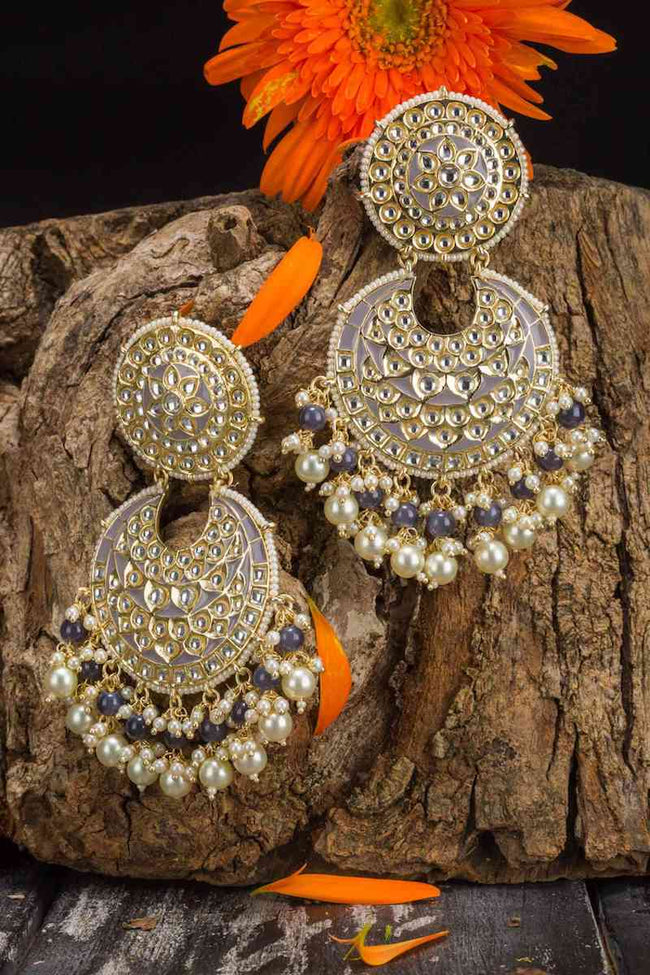
The biggest pair here
Grey Meenakari Statement Chandbali Earrings
Grey is the colour nobody thinks of and everybody notices — cool enough for a monochrome outfit, and it works where gold would look overdone.
Shop nowHow to choose a colour without matching your outfit
The instinct is to match. Blue saree, blue earrings. It's the wrong instinct almost every time, because matching removes the contrast that makes jewellery visible in the first place.
What works instead:
- Neutral outfit, coloured earrings. Cream, ivory, white and beige are the best backdrops in Indian dressing. Rani pink, blue or orange against them becomes the only colour in the look.
- Coloured outfit, gold earrings. If the saree is already doing the work, don't add a second colour. Gold sits beside anything.
- Printed or embroidered outfit, gold or antique. A coloured stone disappears against a busy fabric. A metallic tone doesn't.
- Pick up a secondary colour, not the main one. If the saree is green with a mustard border, mustard earrings look styled. Green earrings look like a set.
The exception is a full traditional bridal look, where matching is the convention — but as a guest, that isn't the situation you're dressing for.
Three practical things nobody tells you
Weight comes from solid metal, not size. A large hollow jhumka is often lighter than a small solid one, so don't rule out a big pair on the assumption it will hurt. Check the construction, not the dimensions.
Use ear discs. A small clear plastic disc behind the earring back spreads the weight across the lobe instead of concentrating it at the piercing. On a six-hour function this is the difference between comfortable and counting the minutes. They cost almost nothing and nobody can see them.
Wear your hair up. A jhumka's entire appeal is movement, and it's completely lost under loose hair. If you're wearing statement earrings, they need to be visible.
What this jewellery is made of, and how to look after it
Handcrafted meenakari, kundan and temple jewellery is made in gold-plated alloy rather than stainless steel. That's a requirement, not a shortcut — hand-painted enamel and hand-set kundan cannot be produced on steel, which is too hard to work at this level of detail. The craft and the metal come together.
The trade is care. These pieces need to stay dry and be stored properly, and they aren't built for daily wear. Treated as occasion jewellery, they hold their finish for years.
- Keep away from water, perfume, lotion and sweat entirely
- Put jewellery on last, after makeup and perfume have dried
- Wipe gently with a soft dry cloth after each wear
- Store in a dry airtight pouch, not loose in a box
If you want earrings for everyday wear rather than functions, the anti-tarnish stainless steel range is built for exactly that — it's a different material for a different job.
The short version
- Mehendi and haldi: mid-size, bright colour, nothing that catches
- Sangeet: go big, go contrasting
- Wedding: gold, antique or temple — it goes with everything
- Reception: oxidised, architectural, cool-toned
- Always: big earrings mean no necklace
If you're buying one pair to cover the whole season, make it gold. If you're buying two, add rani pink. Those two between them handle almost every outfit and every function you'll be invited to.
Browse all handcrafted jhumka and chandbali earrings →
Frequently asked questions
What earrings should I wear to an Indian wedding as a guest?
Gold, antique gold or temple-style jhumkas are the safest choice for the ceremony itself, because gold coordinates with every saree colour and both silk and cotton. For a sangeet, a coloured meenakari jhumka in a shade that contrasts with your outfit works better. For daytime functions like mehendi and haldi, choose mid-sized bright jhumkas you can move in. The one rule that applies throughout: if the earrings are large, skip the necklace.
Should my earrings match my saree colour?
Usually not. Matching removes the contrast that makes jewellery visible, and matched colours tend to read as accidental rather than styled. The stronger approach is contrast — coloured earrings against a neutral outfit, or gold earrings against a coloured one. If you want to tie the look together, pick up a secondary colour from the outfit, such as a border or thread detail, rather than the dominant one. Matching is conventional only for full traditional bridal looks, which is not what a guest is dressing for.
What's the difference between a jhumka and a chandbali?
A jhumka is the bell or dome-shaped earring, usually finished with a fringe of pearls or beads around the rim. A chandbali is crescent-shaped — the name comes from chand, meaning moon — and is typically flatter and wider, often built in two or three tiers. Jhumkas read slightly more everyday; chandbalis more formal, which makes them a good choice for evening functions. Both suit sarees, lehengas and kurta sets.
Can I wear the same earrings to more than one function?
Yes, and most guests do. A gold or antique gold pair is the most repeatable, because it works across daytime and evening and with every outfit colour. The functions where it matters least are the ones with the largest guest lists — nobody is auditing your earrings across a five-day wedding. If you want to vary the look without buying more, change your hairstyle and the necklace instead, since those shift the overall effect more than the earrings do.
Are big jhumkas heavy to wear for a whole function?
Weight in jhumkas comes from solid metal rather than size — a large hollow jhumka is often lighter than a small solid one, so size alone is a poor guide. The most useful thing you can do is wear a small clear plastic disc behind the earring back, which spreads the weight across the lobe rather than concentrating it at the piercing. On a long event this makes a substantial difference, and it costs almost nothing.
What jewellery goes with a cotton saree?
Antique gold, oxidised finishes and pearl work suit cotton best, because matte textures complement the fabric rather than competing with it. Bright polished gold and heavy stone-work often look out of place against cotton. Keep the weight down as well — cotton drapes softly and a heavy set pulls the pleats out of shape. Coloured meenakari also works well with cotton, because the colour does the work rather than the shine.
What is meenakari work?
Meenakari is the traditional Indian craft of fusing coloured enamel onto metal by hand. The technique reached India through Persia and became closely associated with Jaipur and Rajasthan, where it is still practised by families of artisans. Each piece is painted individually, which gives the colour a depth that printed or machine-set finishes don't have, and means no two pieces are perfectly identical. It is usually combined with kundan — stones set into gold-toned metal using thin layers of refined metal rather than claws or glue.
How many pairs of earrings do I need for a wedding season?
Two will cover most of it. A gold or antique gold statement pair handles the ceremony, the reception and any function where the outfit is already colourful. A coloured pair — rani pink is the most versatile, because it contrasts with the neutrals most people own — handles the sangeet and the daytime events. A third pair in an oxidised or cool tone is worth adding only if you wear gowns or Indo-western to receptions.
Is handcrafted meenakari jewellery suitable for daily wear?
No — it's occasion jewellery. Meenakari and kundan pieces are made in gold-plated alloy, which is what makes the hand-painted enamel and hand-set stones possible, since that craftsmanship cannot be produced on stainless steel. Alloy needs to stay dry and be stored properly, and daily contact with sweat and humidity will wear the finish. Treated as occasion wear it lasts for years. For genuine everyday earrings, anti-tarnish stainless steel is the right material instead.
What should I not wear to an Indian wedding as a guest?
The conventions vary by region and family, but two hold fairly widely: avoid white or black for the ceremony in North Indian Hindu weddings, since white is associated with mourning and black is considered inauspicious by many families, and avoid full bridal red at the wedding itself. Neither applies at a reception, where black and white are common. On jewellery specifically, the main thing to avoid is wearing a heavy necklace and heavy earrings together — that reads as cluttered rather than festive.